A ZACF statement on the 2010 Soccer World Cup in South Africa

The 2010 Soccer World Cup must be exposed for the utter sham that it is. The ZACF strongly condemns the audacity and hypocrisy of the government in presenting the occasion as a “once-in-a-lifetime” opportunity for the economic and social upliftment of those living in South Africa (and the rest of the continent). What is glaringly clear is that the “opportunity” is and continues to be that of a feeding-frenzy for global and domestic capital and the South African ruling elite. In fact, if anything, the event is more likely to have devastating consequences for South Africa’s poor and working class – a process that is already underway.
In preparing to host the World Cup the government has spent close to R800 billion (R757 billion on infrastructure development and R30 billion on stadiums that will never be filled again), a massive slap in the face for those living in a country characterized by desperate poverty and close to 40% unemployment. Over the past five years the working poor have expressed their outrage and disappointment at the government’s failure to redress the massive social inequality in over 8,000 service delivery protests for basic services and housing countrywide. This pattern of spending is further evidence of the maintenance of the failed neoliberal capitalist model and its “trickle down” economics, which have done nothing but deepen inequality and poverty globally. Despite previous claims to the contrary, the government has recently admitted this by doing an about turn, and now pretends that the project was “never intended” to be a profit making exercise [1].
South Africa desperately needs large-scale public infrastructure, especially in the area of public transport which is in some cities, including Johannesburg, is almost entirely absent. The Gautrain, which was launched on Tuesday the 8th June (just in time for the big event) is probably the biggest irony here: in a country where the large majority rely on unsafe private mini-bus taxis to travel long distances on a daily basis, the Gautrain offers high speed, luxury transport for tourists and those travelling between Johannesburg and Pretoria… who can afford it if a single trip between the airport and Sandton will set you back a massive R100. The same picture reveals itself everywhere: the Airports company of South Africa (ACSA) has spent over R16 billion on upgrading the airports, the commercialized South African National Road Agency Ltd (SANRAL) has spent over R23 billion on a new network of toll roads – all of which will implement strict cost-recovery measures to recoup the billions spent, and most of which will be of little benefit to poor South Africans. All over the country municipalities have embarked on urban regeneration schemes… accompanied by corresponding gentrification schemes, as the government attempts to hastily paper over the harsh South African reality. Over 15,000 homeless people and street children have been rounded up and dumped in shelters in Johannesburg alone, in Cape Town the municipality has evicted thousands of people from poor areas and squatter camps as part of the World Cup vanity project. The City of Cape Town (unsuccessfully) attempted to evict 10,000 Joe Slovo residents from their homes in order to hide them from the tourists travelling along the N2 highway, and elsewhere they are being removed to make space for stadiums, fan parks or train stations [2]. In Soweto, roads are being beautified along main tourist and FIFA routes, while adjacent schools sport broken windows and crumbling buildings.
Although many South Africans remain unconvinced, others are inundated and swept along by the deluge of nationalist propaganda aimed at diverting attention from the circus that is the World Cup. Every Friday has been deemed “soccer Friday”, in which the “nation” is encouraged (and school children forced) to sport Bafana-Bafana t-shirts. Cars are kitted out in flags, people learn the “Diski-dance” which is performed regularly at every tourist restaurant, and buy Zakumi mascot dolls. Anyone sceptical of the hype is denigrated unpatriotic, the prime example being when appeals were made to striking South African Transport and Allied Workers Union (SATAWU) workers to shelve their concerns “in the national interest” [3]. In a context where close to a million jobs have been lost over the course of the past year, government celebrations that the world cup has created over 400 000 jobs are empty and insulting. The jobs that have been created in the run up have been mostly casual or “Limited Duration Contracts (LCDs)”, taken by workers that are not unionized and paid well below the minimum wage.
Apart from the repression of unions, social movements have received similar hostility from the state, which has unofficially put a blanket ban on all protest for the duration of the event. In fact there is some evidence that this has been in place since as early as the 1st March. According to Jane Duncan:
A snap survey conducted at the end of last week of other municipalities hosting World Cup matches revealed that a blanket ban on gatherings is in operation. According to the Rustenberg municipality, “gatherings are closed for the World Cup”. The Mbombela municipality was told by the SAPS that they were not going to allow gatherings during the World Cup. The Cape Town City Council claimed that it continues to accept applications for marches, but indicated that it “may be a problem” during the World Cup period. According to the Nelson Mandela Bay and Ethekwini municipalities, the police will not allow gatherings over the World Cup period [4].
Although it is clear that the constitution, often hailed for its “progressiveness” is far from the guarantor of freedom and equality that government claims it to be, this new form of repression is clearly in contradiction with the constitutional right to freedoms of expression and gathering. However, social movements in Johannesburg including the Anti-Privatisation Forum and several others have not given up so easily, having managed to get authorization for a protest march on the day of the opening with the help of the Freedom of Expression Institute. However, the march is being forced to be held three kilometres from the stadium where it will not attract the sort of media attention the government is worried about.
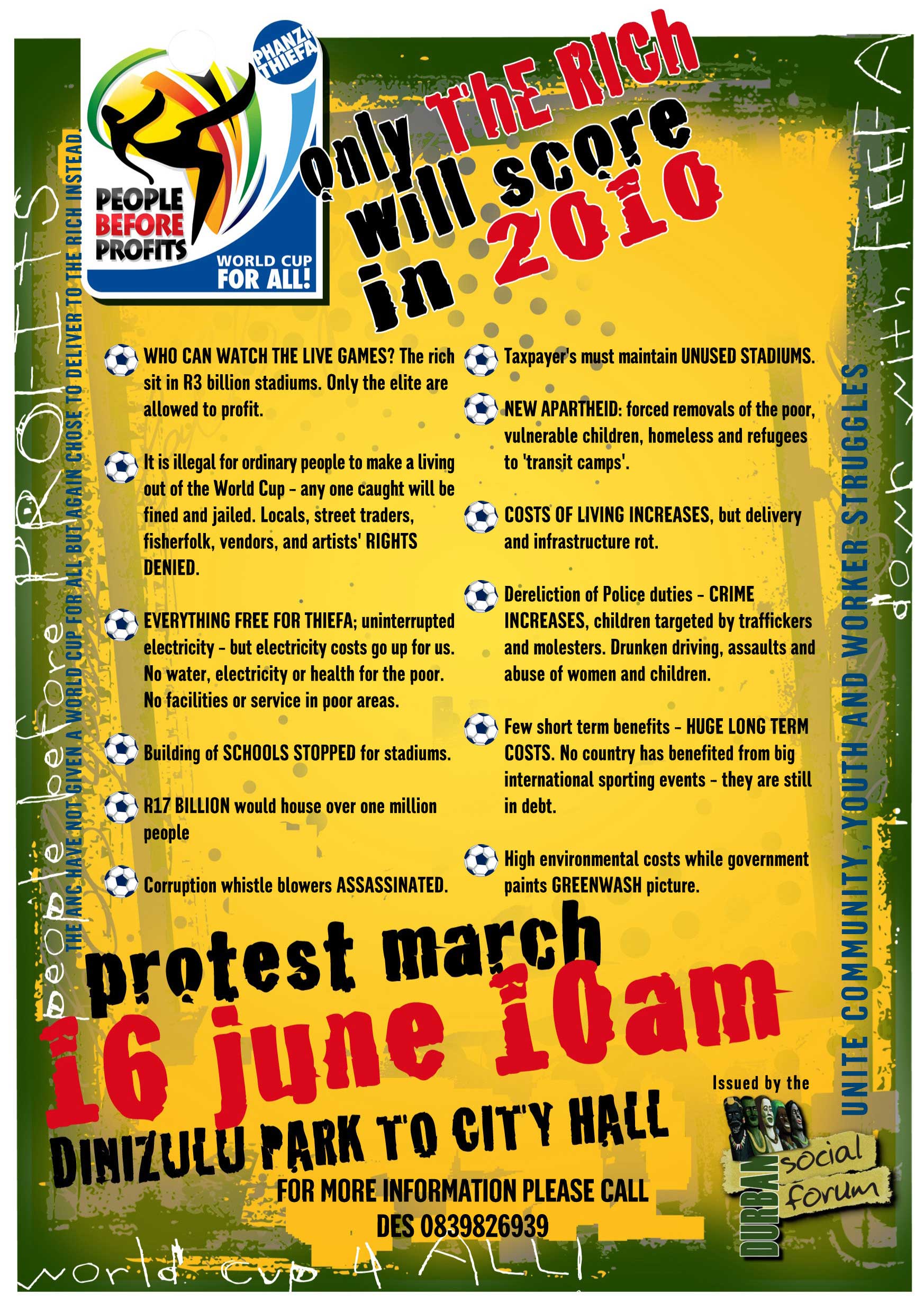
Not only has the state been repressively severe on the poor and any anti-World Cup demonstration or activity, all within the guise of painting South Africa as a host flinging its arms open in invitation to those flocking to its upmarket hotels, bed-and-breakfasts and cocktail lounges, but it does so under the guidance of Sepp Blatter & Friends’ legal criminal empire called FIFA (wonderfully referred to as THIEFA by the Durban Social Forum). Not only are they expected to benefit from a 2010 windfall of nearly € 1.2 billion, but have already gained over € 1 billion from media rights alone.
The stadia, and areas around the stadia, which were handed over to FIFA for the duration of the tournament (“tax-free cocoons” literally creating FIFA-controlled and monitored areas exempt from normal taxation and other State laws), and all routes to and from the stadia have been forcibly cleared of anyone selling non-sanctioned FIFA products and those eking out an existence in squatter camps along airport roads. As such, people who would have banked on World Cup sales to boost their survival incomes are left out in the “trickle down” cold.
FIFA, as sole owner of the World Cup brand and its spin-off products, also has a team of approximately 100 lawyers scouring the country for any unauthorized selling of these products and marketing of the brand. These products are seized and sellers are arrested despite the fact that most in South Africa and on the continent purchase their products from the informal trading sector, as very few have R400 to dole out on team t-shirts and other gear. It has also has effectively gagged journalists with an accreditation clause that prevents media organizations from bringing FIFA into disrepute, clearly compromising freedom of press [5].
The major irony is that soccer was once truly the game of the working class. Viewing games live at stadia was cheap and easily accessible to people who chose to spend 90 minutes forgetting about the daily drudgery of their lives under the boot of the boss and the State. Today, professional football and the World Cup bring exorbitant profits to a small cabal of a global and domestic elite (with billions spent unnecessarily and in a time of a global capitalist crisis) who charge patrons thousands of rands, pounds, euros, etc. every season to watch disgustingly overpaid footballers fall and dive all over manicured pitches at the slightest tug and who squabble, via parasitic agents, over whether or not they are deserving of their huge salaries. A game, which in many respects maintains its aesthetic beauty, has lost its working-class soul and has been reduced to just another set of commodities to be exploited.
Bakunin once said that “people go to church for the same reasons they go to a tavern: to stupefy themselves, to forget their misery, to imagine themselves, for a few minutes anyway, free and happy”. Perhaps, amongst all the blindly nationalistic flag waving and vuvuzela-blowing, we can add sport to his equation and that it might seem easier to forget than to actively partake in combating injustice and inequality. There are many who do, though, and the working class and poor and their organisations are not as malleable to illusion as the government would want to believe. From temporary squatter camp constructions at the doors of the stadia, to mass protest and demonstrations, to countrywide strike action, unsanctioned or not, despite the taunts and jeers and the labels of being “unpatriotic”, or blanket bans on freedom of speech, we will defiantly make our voices heard to expose the terrible inequalities characterising our society and the global games played at the expense of the lives of those upon whom empires are built and will be, ultimately, destroyed.
DOWN WITH THE WORLD CUP!
Phansi state repression and divisive nationalism!
Phambili the people’s struggle against exploitation and profiteering!
This statement was issued by the Zabalaza Anarchist Communist Front

For more information and other articles of critique see:
http://www.ukzn.ac.za/ccs/default.asp?2,40,5,2037
http://antieviction.org.za/
http://www.abahlali.org/
For other articles and statements on the current climate of struggle and repression in South Africa see:
Notes
1 See Star Business Report, Monday 7th June, 2010
2 http://antieviction.org.za/2010/03/25/telling-the-world-that-neither-this-city-nor-the-world-cup-works-for-us/
3 http://www.politicsweb.co.za/politicsweb/view/politicsweb/en/page71654?oid=178399&sn=Detail
4 For article see http://www.sacsis.org.za/site/article/489.1
5 http://www.sportsjournalists.co.uk/blog/?p=2336


 http://www.azadi-b.com/J/2010/07/post_44.html