Tuesday, July 20, 2010

IDF soldier who shot British peace activist to be released from jail


British peace activist Thomas Hurndall who was killed by the IDF in the Gaza Strip in April 2003.

IDF soldier who shot British peace activist to be released from jail

A former IDF soldier who was found guilty of manslaughter in the 2003 shooting death of British peace activist Thomas Hurndall in the Gaza Strip will be released early from prison next month.
Taysir Heib was sentenced in 2005 to eight years in prison for manslaughter as well as obstruction of justice and giving false testimony. The decision to shorten his sentence was made by an army committee, against the advice of Military Advocate General Brig. Gen. Avichai Mendelblit.Hurndall, a 22-year-old student, was shot in the head in April 2003 as he was photographing the work of International Solidarity Movement activists. Witnesses said Hurndall had been helping Palestinian children avoid IDF tanks.

In his investigation, Heib initially claimed he had fired on an armed Palestinian, enlisting supporting testimony from another soldier in his unit. A few months later, however, the second soldier told Military Police investigators that he had not witnessed the incident.
In the verdict, the judges upheld all the arguments of the military prosecution, outlining and emphasizing the series of false and contradictory versions of the incident provided by Heib throughout the investigation.
The judges found that Heib had shot Hurndall with a sniper's rifle, using a telescopic sight, and that Heib had given a "confused and pathetic" version of events to the court.
The court also referred to a confession by the defendant in which he said he had wanted to teach Hurndall a lesson for entering a forbidden zone. Heib admitted to aiming 10 centimeters to the left of Hurndall's head to frighten him and inadvertently shooting the activist.
ISM members often place themselves between IDF troops and Palestinians in an effort to prevent military operations.
Sophie Hurndall, Tom's older sister, said the family had not been informed by Israeli authorities about the early release, but rather found out about it when someone from the British foreign office called with the news.
“We have not had time to regroup or work out what is going on. We have barely had time to process the news and we all feel angry and shocked,” she said, adding that they had long feared such a thing would happen. “We have had to deal with cover ups and lies and a total lack of accountability throughout - and this is in line with that. It's symptomatic.”
Hurndall said the family’s anger is not focused on Heib himself, but rather on the IDF and Israel as a whole.
“To be honest, it’s about the system. Not the man himself. This man who shot Tom was the same age as him. He is both the victim and the killer. He is part of a system that proactively encouraged soldier to target civilian," she said.
.
As Hunrdall sees it, the early release sends a message from Israeli to its young soldiers, "telling them 'do what you want. We have your back.’”
Israel, she concluded, simply does not care what people think of it in the international community: “So many innocent [people] killed in so many horrific ways. They just don’t seem to care about anyone.”
Hurndall also criticized her own government, which, under the leadership of then-prime minister Tony Blair, did not come out, she claims, strongly against the killing and now has had a muted response as well.

“It's incredibly sad. One of the things that happened to me since my brother was killed is that I have lost faith in humanity. I cannot believe that people can do such things, and that my own government can sit by and keep quiet," she said.
 
The British Foreign Office issued an official statement in response, saying "we note the court's decision today to release Taysir Heib and recognize the grief this decision will cause to the Hurndall family. We have the deepest of sympathies for the Hurndall family. Tom's death was a tragedy."

Saturday, July 3, 2010

From the Mara Soil - Film Trailer


FROM THE MARA SOIL takes you to a stunning but impoverished region in Tanzania, where a handful of activists are fighting food scarcity, water shortage, disease, health problems, and deforestation by teaching their people to use Mother Nature to lift themselves out of poverty.

FILM COMING JULY 2010.

Produced by Global Resource Alliance.
Directed by Steve Schrenzel.

http://www.globalresourcealliance.org/

Friday, July 2, 2010

Greece is a microcosm of a modern class war rarely reported as such.

undefined

As Britain's political class pretends that its arranged marriage of Tweedledee to Tweedledum is democracy, the inspiration for the rest of us is Greece. It is hardly surprising that Greece is presented not as a beacon, but as a "junk country" getting its comeuppance for its "bloated public sector" and "culture of cutting corners" (Observer). The heresy of Greece is that the uprising of its ordinary people provides an authentic hope unlike that lavished upon the warlord in the White House.

The crisis that has led to Greece's "rescue" by European banks and the International Monetary Fund is the product of a grotesque financial system that itself is in crisis. Greece is a microcosm of a modern class war rarely reported as such, but waged with all the urgency of panic among the imperial rich.

What makes Greece different is that it has experienced, within living memory, invasion, foreign occupation, military dictatorship and popular resistance. Ordinary people are not cowed by the corrupt corporatism that dominates the European Union. The right-wing government of Kostas Karamanlis that preceded the present Pasok (Labour) government of George Papandreou was described by the sociologist Jean Ziegler as "a machine for systematically pillaging the country's resources".
Epic theft

The machine had infamous friends. The US Federal Reserve board is investigating the role of Goldman Sachs, which gambled on the bankruptcy of Greece as public assets were sold off and its tax-evading rich deposited €360bn in Swiss banks. This haemorrhaging of capital continues with the approval of Europe's central banks and governments.

At 11 per cent, Greece's budget deficit is no higher than America's. However, when the Papandreou government tried to borrow on the international capital market, it was effectively blocked by the US corporate ratings agencies, which "downgraded" Greek debt to "junk". These same agencies gave triple-A ratings to billions of dollars in so-called sub-prime mortgage securities and so precipitated the economic collapse in 2008.

What has happened in Greece is theft on an epic, though not unfamiliar, scale. In Britain, the "rescue" of banks such as Northern Rock and the Royal Bank of Scotland has cost billions of pounds. Thanks to Gordon Brown and his passion for the avaricious instincts of the City, these gifts of public money were unconditional, and the bankers have continued to pay each other the booty they call bonuses and to spirit it away to tax havens. Under Britain's political monoculture, they can do as they wish. In the US, the situation is even more remarkable. As the investigative journalist David DeGraw has reported, the principal Wall Street banks that "destroyed the economy pay zero in taxes and get $33bn in refunds".

In Greece, as in America and Britain, the ordinary people have been told they must repay the debts of the rich and powerful who incurred them. Jobs, pensions and public services are to be slashed and burned, with privateers put in charge. For the EU and the IMF, the opportunity presents to "change the culture" and to dismantle the social welfare of Greece, just as the IMF and the World Bank have "structurally adjusted" (impoverished and controlled) countries across the developing world.

Greece is hated for the same reason Yugo­slavia had to be destroyed physically behind a pretence of protecting the people of Kosovo. Most Greeks are employed by the state, and the young and the trade unions comprise a popular alliance that has not been pacified; the colonels' tanks on the campus of Athens University in 1967 remain a political spectre. Such resistance is anathema to Europe's central bankers and regarded as an obstruction to German capital's need to capture markets in the aftermath of Germany's troubled reunification.
Shock therapy

In Britain, such has been the 30-year propaganda of an extreme economic theory known first as monetarism, then as neoliberalism, that the new Prime Minister can, like his predecessor, describe his demands that ordinary people pay the debts of crooks as "fiscally responsible". The unmentionables are poverty and class.

Almost a third of British children remain below the breadline. In working-class Kentish Town in London, male life expectancy is 70. Two miles away, in Hampstead, it is 80. When Russia was subjected to similar "shock therapy" in the 1990s, life expectancy nosedived. In the United States, a record 40 million cannot afford to feed themselves.

In the developing world, a system of triage imposed by the World Bank and the IMF has long determined whether people live or die. Whenever tariffs and food and fuel subsidies are eliminated by IMF diktat, small farmers know they have been declared expendable. The World Resources Institute estimates that the toll reaches between 13 and 18 million child deaths every year. This, wrote the economist Lester C Thurow, is "neither metaphor nor simile of war, but war itself".

The same imperial forces have used horrific weapons against stricken countries where children are the majority, and approved torture as an instrument of foreign policy. It is a phenomenon of denial that none of these assaults on humanity, in which Britain is actively engaged, was allowed to intrude on the British election.

The people on the streets of Athens do not suffer this malaise. They are clear who the enemy is and regard themselves as once again under foreign occupation. And once again, they are rising up, with courage. When David Cameron begins to cleave £6bn from public services in Britain, he will be bargaining that Greece will not happen in Britain. We should prove him wrong.

www.newstatesman.com/uk-politics/2010/05/greece-pilger-brita...

Thursday, July 1, 2010

World Cup 2010: All in the name of the ‘Beautiful Gain’


A ZACF statement on the 2010 Soccer World Cup in South Africa


The 2010 Soccer World Cup must be exposed for the utter sham that it is. The ZACF strongly condemns the audacity and hypocrisy of the government in presenting the occasion as a “once-in-a-lifetime” opportunity for the economic and social upliftment of those living in South Africa (and the rest of the continent). What is glaringly clear is that the “opportunity” is and continues to be that of a feeding-frenzy for global and domestic capital and the South African ruling elite. In fact, if anything, the event is more likely to have devastating consequences for South Africa’s poor and working class – a process that is already underway.

In preparing to host the World Cup the government has spent close to R800 billion (R757 billion on infrastructure development and R30 billion on stadiums that will never be filled again), a massive slap in the face for those living in a country characterized by desperate poverty and close to 40% unemployment. Over the past five years the working poor have expressed their outrage and disappointment at the government’s failure to redress the massive social inequality in over 8,000 service delivery protests for basic services and housing countrywide. This pattern of spending is further evidence of the maintenance of the failed neoliberal capitalist model and its “trickle down” economics, which have done nothing but deepen inequality and poverty globally. Despite previous claims to the contrary, the government has recently admitted this by doing an about turn, and now pretends that the project was “never intended” to be a profit making exercise [1].

South Africa desperately needs large-scale public infrastructure, especially in the area of public transport which is in some cities, including Johannesburg, is almost entirely absent. The Gautrain, which was launched on Tuesday the 8th June (just in time for the big event) is probably the biggest irony here: in a country where the large majority rely on unsafe private mini-bus taxis to travel long distances on a daily basis, the Gautrain offers high speed, luxury transport for tourists and those travelling between Johannesburg and Pretoria… who can afford it if a single trip between the airport and Sandton will set you back a massive R100. The same picture reveals itself everywhere: the Airports company of South Africa (ACSA) has spent over R16 billion on upgrading the airports, the commercialized South African National Road Agency Ltd (SANRAL) has spent over R23 billion on a new network of toll roads – all of which will implement strict cost-recovery measures to recoup the billions spent, and most of which will be of little benefit to poor South Africans. All over the country municipalities have embarked on urban regeneration schemes… accompanied by corresponding gentrification schemes, as the government attempts to hastily paper over the harsh South African reality. Over 15,000 homeless people and street children have been rounded up and dumped in shelters in Johannesburg alone, in Cape Town the municipality has evicted thousands of people from poor areas and squatter camps as part of the World Cup vanity project. The City of Cape Town (unsuccessfully) attempted to evict 10,000 Joe Slovo residents from their homes in order to hide them from the tourists travelling along the N2 highway, and elsewhere they are being removed to make space for stadiums, fan parks or train stations [2]. In Soweto, roads are being beautified along main tourist and FIFA routes, while adjacent schools sport broken windows and crumbling buildings.

Although many South Africans remain unconvinced, others are inundated and swept along by the deluge of nationalist propaganda aimed at diverting attention from the circus that is the World Cup. Every Friday has been deemed “soccer Friday”, in which the “nation” is encouraged (and school children forced) to sport Bafana-Bafana t-shirts. Cars are kitted out in flags, people learn the “Diski-dance” which is performed regularly at every tourist restaurant, and buy Zakumi mascot dolls. Anyone sceptical of the hype is denigrated unpatriotic, the prime example being when appeals were made to striking South African Transport and Allied Workers Union (SATAWU) workers to shelve their concerns “in the national interest” [3]. In a context where close to a million jobs have been lost over the course of the past year, government celebrations that the world cup has created over 400 000 jobs are empty and insulting. The jobs that have been created in the run up have been mostly casual or “Limited Duration Contracts (LCDs)”, taken by workers that are not unionized and paid well below the minimum wage.

Apart from the repression of unions, social movements have received similar hostility from the state, which has unofficially put a blanket ban on all protest for the duration of the event. In fact there is some evidence that this has been in place since as early as the 1st March. According to Jane Duncan:

A snap survey conducted at the end of last week of other municipalities hosting World Cup matches revealed that a blanket ban on gatherings is in operation. According to the Rustenberg municipality, “gatherings are closed for the World Cup”. The Mbombela municipality was told by the SAPS that they were not going to allow gatherings during the World Cup. The Cape Town City Council claimed that it continues to accept applications for marches, but indicated that it “may be a problem” during the World Cup period. According to the Nelson Mandela Bay and Ethekwini municipalities, the police will not allow gatherings over the World Cup period [4].

Although it is clear that the constitution, often hailed for its “progressiveness” is far from the guarantor of freedom and equality that government claims it to be, this new form of repression is clearly in contradiction with the constitutional right to freedoms of expression and gathering. However, social movements in Johannesburg including the Anti-Privatisation Forum and several others have not given up so easily, having managed to get authorization for a protest march on the day of the opening with the help of the Freedom of Expression Institute. However, the march is being forced to be held three kilometres from the stadium where it will not attract the sort of media attention the government is worried about.

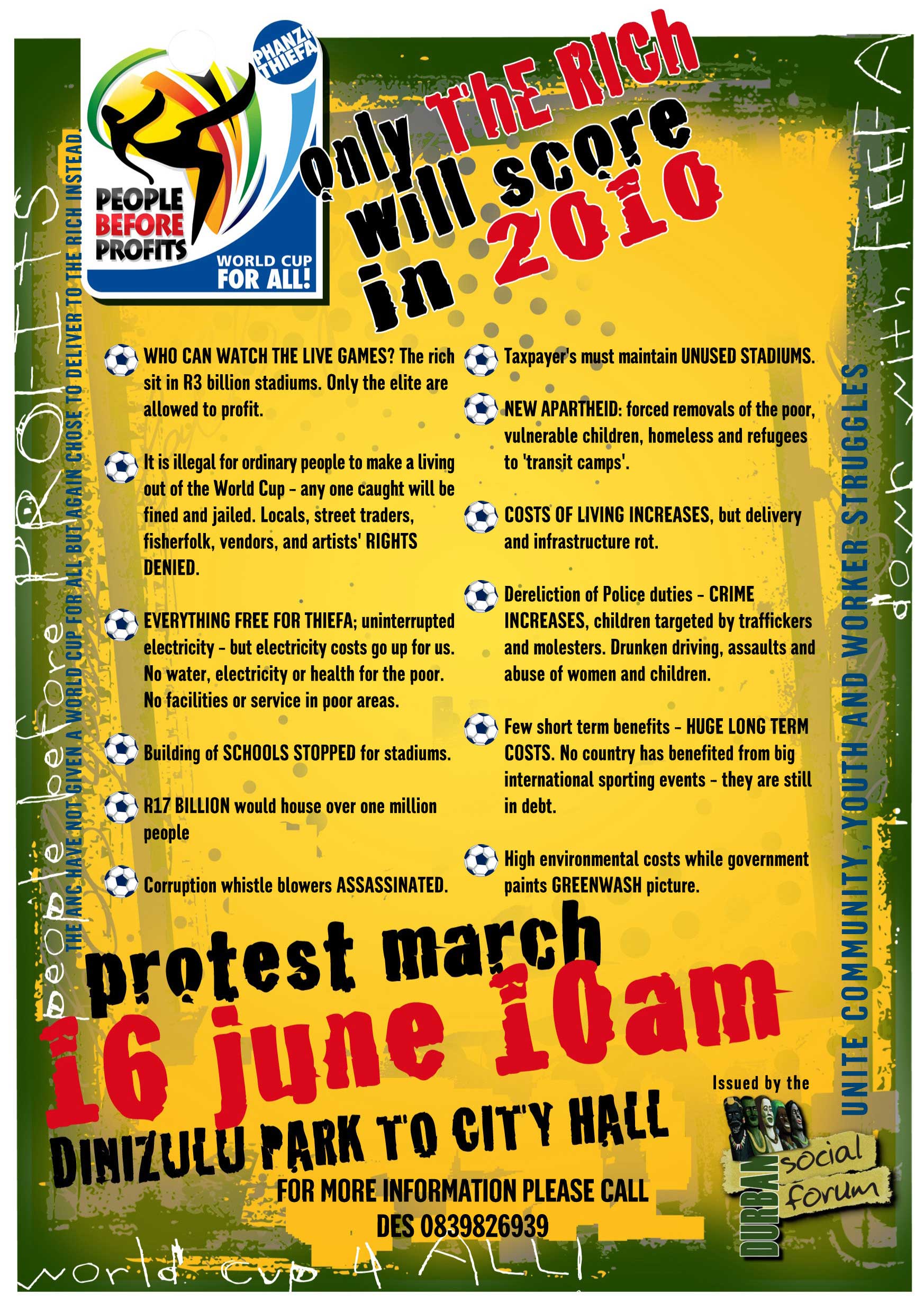
Not only has the state been repressively severe on the poor and any anti-World Cup demonstration or activity, all within the guise of painting South Africa as a host flinging its arms open in invitation to those flocking to its upmarket hotels, bed-and-breakfasts and cocktail lounges, but it does so under the guidance of Sepp Blatter & Friends’ legal criminal empire called FIFA (wonderfully referred to as THIEFA by the Durban Social Forum). Not only are they expected to benefit from a 2010 windfall of nearly € 1.2 billion, but have already gained over € 1 billion from media rights alone.

The stadia, and areas around the stadia, which were handed over to FIFA for the duration of the tournament (“tax-free cocoons” literally creating FIFA-controlled and monitored areas exempt from normal taxation and other State laws), and all routes to and from the stadia have been forcibly cleared of anyone selling non-sanctioned FIFA products and those eking out an existence in squatter camps along airport roads. As such, people who would have banked on World Cup sales to boost their survival incomes are left out in the “trickle down” cold.

FIFA, as sole owner of the World Cup brand and its spin-off products, also has a team of approximately 100 lawyers scouring the country for any unauthorized selling of these products and marketing of the brand. These products are seized and sellers are arrested despite the fact that most in South Africa and on the continent purchase their products from the informal trading sector, as very few have R400 to dole out on team t-shirts and other gear. It has also has effectively gagged journalists with an accreditation clause that prevents media organizations from bringing FIFA into disrepute, clearly compromising freedom of press [5].

The major irony is that soccer was once truly the game of the working class. Viewing games live at stadia was cheap and easily accessible to people who chose to spend 90 minutes forgetting about the daily drudgery of their lives under the boot of the boss and the State. Today, professional football and the World Cup bring exorbitant profits to a small cabal of a global and domestic elite (with billions spent unnecessarily and in a time of a global capitalist crisis) who charge patrons thousands of rands, pounds, euros, etc. every season to watch disgustingly overpaid footballers fall and dive all over manicured pitches at the slightest tug and who squabble, via parasitic agents, over whether or not they are deserving of their huge salaries. A game, which in many respects maintains its aesthetic beauty, has lost its working-class soul and has been reduced to just another set of commodities to be exploited.

Bakunin once said that “people go to church for the same reasons they go to a tavern: to stupefy themselves, to forget their misery, to imagine themselves, for a few minutes anyway, free and happy”. Perhaps, amongst all the blindly nationalistic flag waving and vuvuzela-blowing, we can add sport to his equation and that it might seem easier to forget than to actively partake in combating injustice and inequality. There are many who do, though, and the working class and poor and their organisations are not as malleable to illusion as the government would want to believe. From temporary squatter camp constructions at the doors of the stadia, to mass protest and demonstrations, to countrywide strike action, unsanctioned or not, despite the taunts and jeers and the labels of being “unpatriotic”, or blanket bans on freedom of speech, we will defiantly make our voices heard to expose the terrible inequalities characterising our society and the global games played at the expense of the lives of those upon whom empires are built and will be, ultimately, destroyed.

DOWN WITH THE WORLD CUP!

Phansi state repression and divisive nationalism!
Phambili the people’s struggle against exploitation and profiteering!

This statement was issued by the Zabalaza Anarchist Communist Front

undefined

For more information and other articles of critique see:

http://www.ukzn.ac.za/ccs/default.asp?2,40,5,2037
http://antieviction.org.za/
http://www.abahlali.org/

For other articles and statements on the current climate of struggle and repression in South Africa see:


Notes

1 See Star Business Report, Monday 7th June, 2010
2 http://antieviction.org.za/2010/03/25/telling-the-world-that-neither-this-city-nor-the-world-cup-works-for-us/
3 http://www.politicsweb.co.za/politicsweb/view/politicsweb/en/page71654?oid=178399&sn=Detail
4 For article see http://www.sacsis.org.za/site/article/489.1
5 http://www.sportsjournalists.co.uk/blog/?p=2336

Friday, June 25, 2010

West Papua - The secret war in Asia (2007 - 15min)


undefined

http://www.freewestpapua.de/
http://www.freewestpapua.org/
http://www.naturvoelker.org/

The film describes the situation of the West Papuan refugees in Papua New Guinea as well as the history of the annexation by Indonesia and exploitation of natural resources with many interviews, high lighted with an interview from Mathias Wenda. The video got his premiere at the Venice Biennale 2007. The film is made from fPcN Germany.

The film tells the story the forgotten war against tribal people on the island of New Guinea. The western part of the island, West Papua, is annexed by Indonesia and exploited by international companies. The West Papuans struggle for their independence from Indonesia. At least 100.000 Papuans has lost their lives in this conflict.

Watch online:
http://www.fpcn-global.org/content/West-Papua-The-secret-war-Asia-2007-15min
---or---
http://video.google.com/videoplay?docid=-6707054975859244286
---or---
http://www.engagemedia.org/Members/fPcN_interCultural/videos/The_secret_war.mov/view

Direct Download:
http://www.engagemedia.org/Members/fPcN_interCultural/videos/The_secret_war.mov
You might also like:

Greece puts its islands up for sale to save economy

Desperate attempt to repay debts also driven by inability to find funds to develop infrastructure on islands

by Elena Moya

Greece is raising cash by selling off an area of state-owned land on Mykonos for luxury tourism. Photograph: Getty Images

There's little that shouts "seriously rich" as much as a little island in the sun to call your own. For Sir Richard Branson it is Neckar in the Caribbean, the billionaire Barclay brothers prefer Brecqhou in the Channel Islands, while Aristotle Onassis married Jackie Kennedy on Skorpios, his Greek hideway.

Now Greece is making it easier for the rich and famous to fulfill their dreams by preparing to sell, or offering long-term leases on, some of its 6,000 sunkissed islands in a desperate attempt to repay its mountainous debts.

The Guardian has learned that an area in Mykonos, one of Greece's top tourist destinations, is one of the sites for sale. The area is one-third owned by the government, which is looking for a buyer willing to inject capital and develop a luxury tourism complex, according to a source close to the negotiations.

Potential investorsalso looking at property on the island of Rhodes, are mostly Russian and Chinese. Investors in both countries are looking for a little bit of the Mediterranean as holiday destinations for their increasingly affluent populations. Roman Abramovich, the billionaire owner of Chelsea football club, is among those understood to be interested, although a spokesman denied he was about to invest.

Greece has embarked on the desperate measures after being pushed into a €110bn (£90bn) bailout by the EU and the IMF last month, following a decade of overspending and after jittery investors raised borrowing costs to unbearable levels.

The sale of an island – or convincing a member of the international jet-set to take on a long-term lease – would help to boost its coffers. The Private Islands website lists 1,235-acre Nafsika, in the Ionian sea, on sale for €15m. But others are on for less than €2m – less than a townhouse in Mayfair or Chelsea. Some of the country's numerous islands are tiny which could barely fit a single sunbed.

Only 227 Greek islands are populated and the decision to press ahead with potential sales has also been driven by the inability of the state to develop basic infrastructure, or police most of its islands. The hope is that the sale or long-term lease of some islands will attract investment that will generate jobs and taxable income.

"I am sad – selling off your islands or areas that belong to the people of Greece should be used as the last resort," said Makis Perdikaris, director of Greek Island Properties. "But the first thing is to develop the economy and attract foreign domestic investment to create the necessary infrastructure. The point is to get money." In its battle to raise funds, the country is also planning to sell its rail and water companies. Chinese investors are understood to be interested in the Greek train system, as they already control some of the ports. In a deal announced earlier this month, the Greek government also agreed to export olive oil to China.

After the socialist government of prime minister Geórgios Papandreou responded to the IMF bailout with draconian budget cuts, rioters took to the streets, costing three lives in May.

In the midst of the crisis, the German chancellor, Angela Merkel, delayed her support as she faced local elections and popular opposition to any public-funded help to Greece.

As strikes almost paralysed the country and hedge funds bet against the economy, German politicians called for Greece to start selling islands, historic buildings and artworks. It now appears that the Greek government has heeded their demands.

The City, where investors are increasingly shunning Greek investments, welcomed any island sales. "It's a shame if it has come to this but it does at least demonstrate that Greece is prepared to take all actions necessary to try and meet its obligations," said Gary Jenkins, a credit analyst at Evolution Securities.

Property prices have fallen between 10% and 20% since the May riots in Athens, as bad publicity has drawn visitors away, Perdikaris said.

"We have experienced a very slow booking season. Most tour operators offer hugely discounted rates," he said. Britons account for more than 60% of his company's property sales.

Tuesday, June 8, 2010

EU social model ‘needs correcting’ to avoid unrest


7 June


Though Europe’s social model proved “resilient” against the economic crisis, it must be “corrected” to prevent increasing social unrest, EU Employment and Social Affairs Commissioner László Andor told EurActiv at the fringes of a meeting with EU trade unions and employers.

EU finance ministers agreed on 9 May to establish a rescue mechanism worth around €750 billion to protect the euro from collapsing under the weight of debt accumulated in countries such as Greece, Spain or Portugal (EurActiv 10/05/10).

Crisis-hit EU countries have adopted highly unpopular austerity measures, which in the case of Greece sparked violent street protests (EurActiv 05/05/10).

The European Commission has developed a blueprint for growth, the ‘Europe 2020′ strategy, which it believes will set Europe on the path to economic recovery. As reported by EurActiv, a number of stakeholders have argued that the Europe 2020 strategy does not have a sufficiently strong social dimension in its current guise (EurActiv 10/03/10).

The term ‘European social partners’ refers to those organisations at EU level which are engaged in the European social dialogue, as provided for under Articles 154 and 155 of the EU Treaties.

Andor confirmed that the European Commission has a “real concern” about social unrest in certain countries where the “financial panic has been out of control”.

He described the need for tough austerity measures in hard-hit countries such as Greece as “inevitable”, adding, however, that EU financial support should help to prevent any severe escalation.

Andor said that these risks should not affect other countries “where this panic doesn’t apply and social unrest can be constrained”.

Specifically, it is essential to maintain a strong social dialogue and fully involve social partners in the development of future plans, he said.

Likewise, he said it was vital to bring forward a convincing strategy for growth and jobs, which is why he believes it is “crucial” that EU leaders give political approval to the Commission’s Europe 2020 strategy at a 17 June summit in Brussels.

In response to the escalating risk of social unrest, he said the EU must continue to reform and “correct” the European social model, as this is the only way to “preserve peace” in the long run.

Sense of urgency ‘missing’, say social partners

Andor was speaking to EurActiv on the sidelines of a 4 June meeting with EU ’social partners’, who were presenting the final input of workers’ unions and employer organisations to the ‘Europe 2020′ strategy for growth and jobs.

Workers and employers joined forces in agreeing that an ambitious growth strategy is the only way to ensure economic recovery.

However, Philippe De Buck, director-general of BusinessEurope, said European employers feel a sense of urgency was missing from the strategy.